Employers are expected to observe due process when dealing with misconduct cases. This includes conducting proper investigations, issuing clear charges, and affording employees an opportunity to be heard.
However, does the obligation go further where the alleged misconduct may be connected to an employee’s medical condition? Must employers give additional consideration to the employee’s illness before proceeding with disciplinary action?
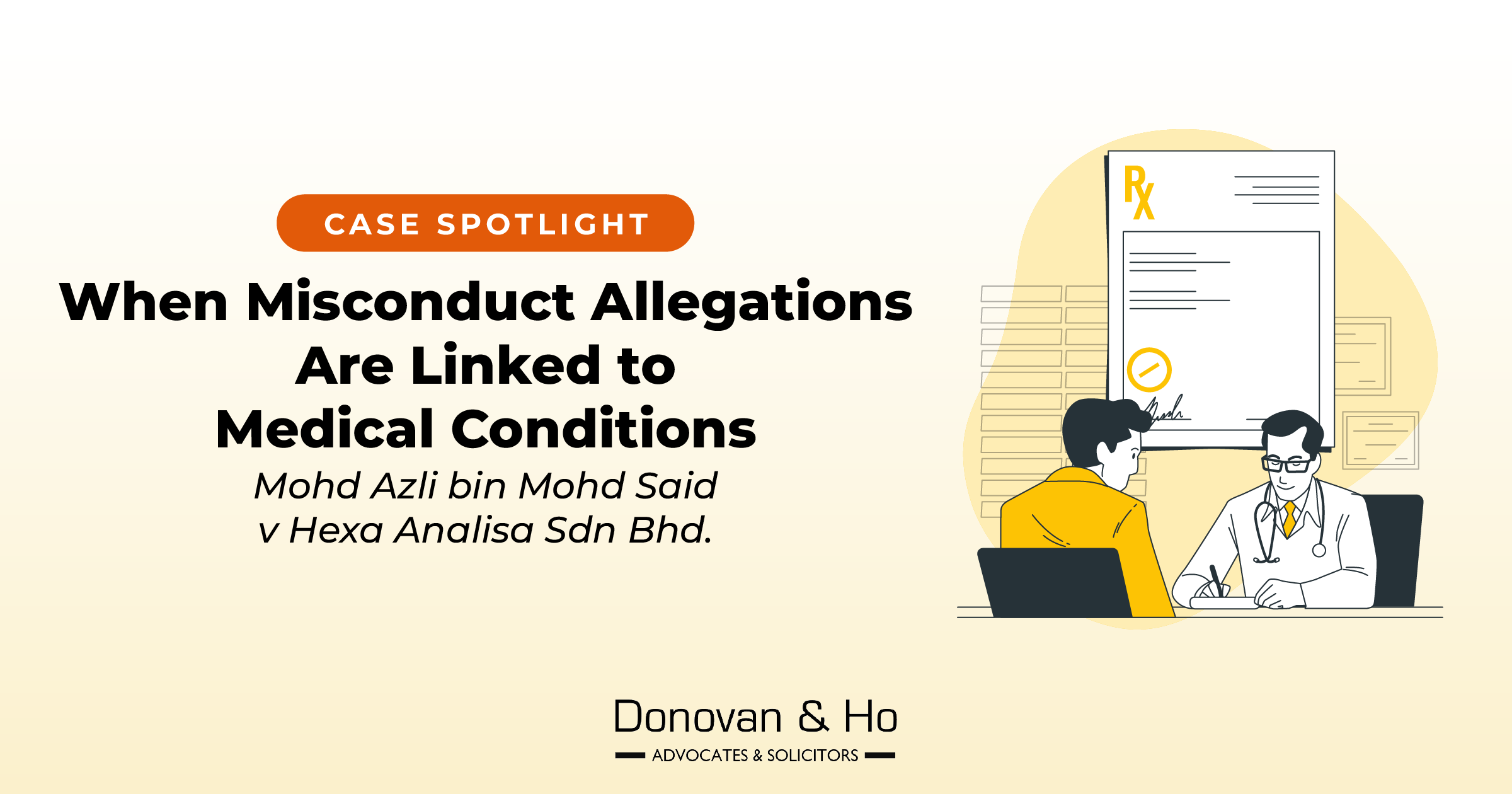
The Industrial Court examined these issues in Mohd Azli bin Mohd Said v Hexa Analisa Sdn Bhd, which involved an employee who was sleeping on the job due to a medical condition.
Factual Background
- The Claimant was employed as a Sales Executive since 2018. Towards the end of 2020, he began suffering from sleep apnea, a medical condition which may cause interrupted sleep, fatigue, and episodes of micro sleep.
- On 20.12.2021, the Claimant informed the Company of his medical condition.
- On 5.1.2022, the Claimant was instructed to undergo a medical examination. On the same day, he was also instructed to return his laptop and handphone without explanation and was issued two warning letters relating to alleged misconduct on 4.1.2022 and 5.1.2022. The Claimant requested additional time to return the devices as he intended to update or organize them first.
- On 6.1.2022 , the Claimant was denied entry into the workplace. He subsequently wrote to the Company seeking clarification regarding his employment status.
- On 9.1.2022 , the Company issued multiple further letters to the claimant, including four warning letters, a notice demanding return of Company property, and a formal instruction to undergo a medical examination.
- On 16.1.2022, the Claimant received a notice to show cause together with a notice of suspension.
- On 20.1.2022, the Claimant received a notice of domestic inquiry, which alleged that he committed 5 misconducts, being:-
Charge 1: Sleeping loudly during working hours and disrupting the workplace environment
Charge 2: Inability to properly perform his duties due to loss of focus
Charge 3: Disobeying instructions from his superior
Charge 4: Misusing Company property and failing to return Company assets within the stipulated timeframe
Charge 5: Leaving the workplace during working hours without reasonable excuse and providing contradictory information
- On 24.1.2022, the Claimant attended the domestic inquiry and his suspension was extended.
- On 28.1.2022, the Claimant was terminated from his employment.
- Aggrieved with his termination, the Claimant filed a claim of unfair dismissal.
Court’s Findings
The Court examined the charges and found that none of the charges were established for the following reasons:-
Charge 1: Although the Company produced photographs allegedly showing the claimant sleeping, the claimant disputed the allegation. More importantly, the Court held that the Company failed to prove a key component of the charge, namely that the claimant’s conduct had disrupted the workplace environment.
Charge 2: The Court found insufficient evidence that the claimant was incapable of performing his work. Importantly, the Court took into account the claimant’s sleep apnea condition, which could result in fatigue and micro sleep episodes.
Charge 3: There was no evidence presented by the Company in relation to this charge.
Charge 4: The Court held that the claimant’s two day delay in returning the laptop and handphone was reasonable in the circumstances.
Charge 5: The Company did not adduce any evidence in support of this charge. On the contrary, the Claimant adduced a screenshot to show that he received Company approval to leave earlier.
The Court further observed that where an employee’s termination is linked to health-related issues, the employer should engage in a proper discussion with the employee regarding the employee’s medical condition and afford the employee an opportunity to be heard on the matter. Such discussions are necessary to assess the employer’s operational requirements, the employee’s ability to continue performing his duties, and the anticipated recovery period.
In the present case, the Court found that no such discussion had taken place.
Key Takeaways
This decision highlights that where misconduct or poor performance may be connected to an employee’s medical condition, employers should avoid treating the matter as a pure disciplinary issue without first assessing the medical aspects involved. Before proceeding with disciplinary action, employers should engage with the employee, understand the nature of the medical condition, assess its impact on the employee’s duties, and consider whether alternative measures such as medical leave, workplace adjustments, or medical boarding out may be more appropriate.
The case also serves as a reminder that due inquiry processes must be evidence based and carefully handled. Merely issuing multiple warning letters or numerous charges will not strengthen an employer’s position if the allegations are unsupported by credible evidence. Employers should ensure that charges are properly drafted, supported by contemporaneous evidence, and proportionate in light of the surrounding circumstances.
Finally, employers should be mindful of the optics and timing of disciplinary action involving employees with known medical conditions. Rapid escalation of disciplinary measures shortly after disclosure of a medical issue may create an impression that the process was predetermined or lacking in good faith, which may ultimately undermine the employer’s case before the Industrial Court.
***
This article was written by Leow Ho Eng (Senior Associate) from Donovan & Ho’s employment law practice.
Donovan & Ho is a law firm in Malaysia, and our employment practice group has built a reputation for providing strategic employment advice to local and global organisations. Our team of employment lawyers provide advice on employment law and industrial relations including review of employment contracts, policies and handbooks, advising on workforce reductions, and managing dismissals of employees for poor performance or misconduct. We also represent clients in unfair dismissal claims and employment-related litigation.
Have a question? Please contact us.