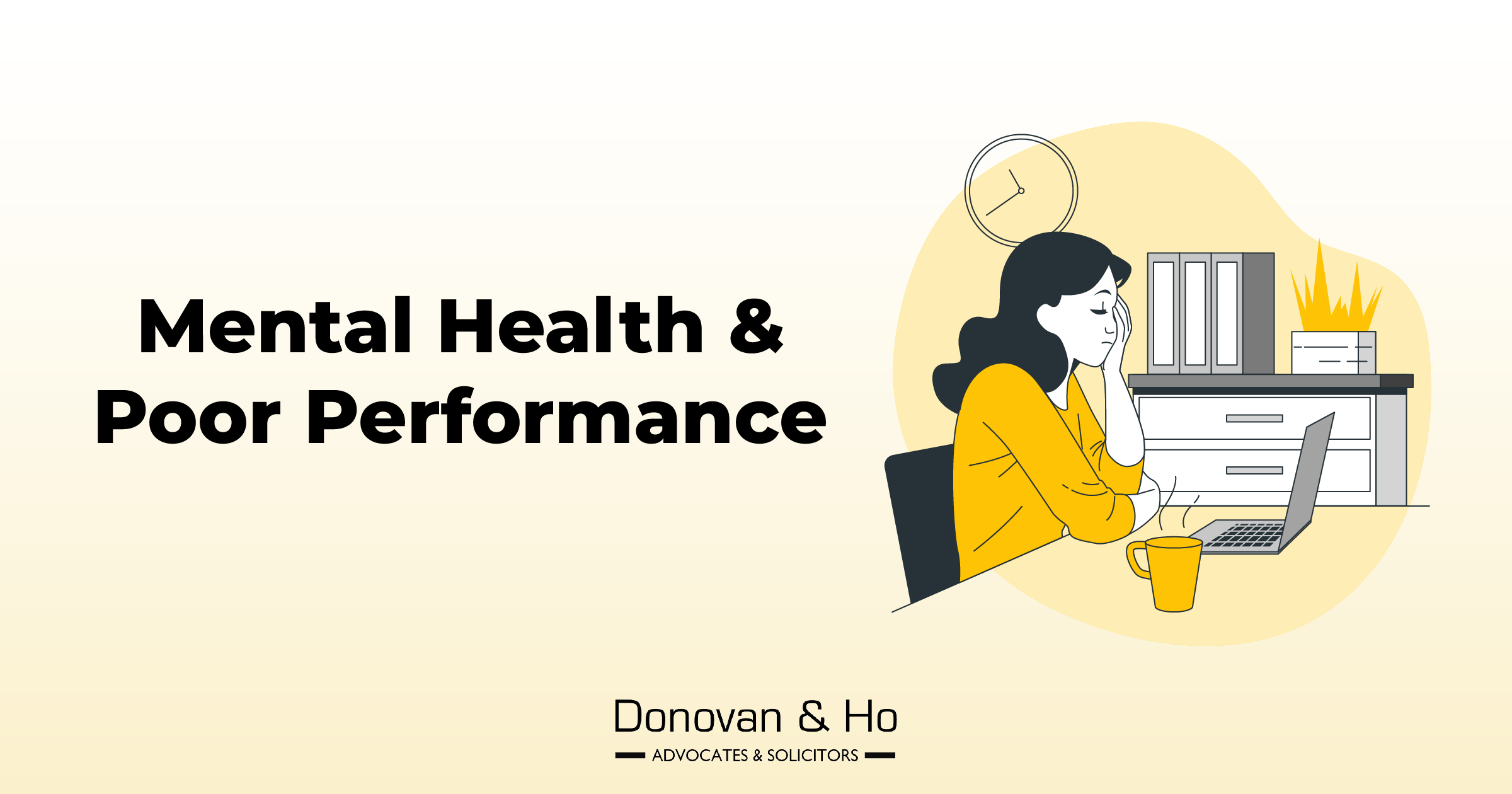
Poor performance constitutes a valid ground for dismissal, since employers have the right to expect a certain standard of competence and productivity from their employees. However, as mental health awareness grows, a critical question emerges: Can an employee use their mental health condition as a justification for poor performance?
In this article, we examine three cases that illustrate the Court’s consideration of an employee’s mental health alongside an employer’s right to satisfactory performance.
Hafizah bt Jumat v The Malaysian Government & Ors [2022] MLJU 2910
This case involves a judicial review application brought by an employee (“the Applicant”) challenging her termination under the Public Officers (Appointment, Promotion and Termination of Service) Regulations 2012.
Brief Facts:
- The Applicant was dismissed due to unsatisfactory performance and taking long periods of sick leave including unapproved leave.
- In the Applicant’s reply to the show cause letter, she attributed her weaknesses and shortcomings to her poor mental health condition, where she was diagnosed and treated for Schizoaffective Disorder, which caused her to take long and frequent sick leave and being unable to carry out her duties satisfactorily.
Court’s Findings:
The Court found that the termination was lawful and did not meet the threshold for judicial intervention. The employer had duly considered the Applicant’s reasons and justifications, but still maintained that the Applicant is unfit for the job.
The Court also held that the employer is the best person to judge whether an employee is suitable for the job and meets the requirements of the department. Thus, it is not for the Court to make its own assessment and findings on the reasons given by the Applicant, and substitute its findings or decision for that of the employer.
Azizah Binti Ahmad v Malayan Banking Berhad [2017] ILJU 71
Brief Facts:
- The company contended that despite being tasked with only two key goals, the employee (a probationer) failed to execute these to the company’s expectations. Her overall performance throughout her tenure was deemed unsatisfactory.
- The employee argued that she worked under highly stressful conditions due to a heavy workload and limited support staff. She claimed she could not cope with the overburdened environment from the start of her employment, leading to a deterioration of her health. The employee further alleged that the company failed to provide proper supervision or guidance, and that she was isolated, victimised, and made her a “scapegoat” for work that had accumulated before she joined the company.
Court’s Findings:
The Court evaluated the evidence and found that the employee exhibited an “attitude problem” and tended to attribute blame to external factors.
While the employee produced a medical letter stating she suffered from “depression and anxiety panic attacks aggravated by phone calls from the office”, the Court held that there was no medical evidence to suggest these sufferings were caused specifically by her workload or being overworked.
As the Court observed, depression and anxiety can stem from many different causes. It concluded that the issues were not necessarily work-related, but that the employee was unable to handle the standard requirements of her workplace. Therefore, the Court found the dismissal to be justified and dismissed the employee’s case.
Raja Halim Muadzam Shah bin Raja Kassim v Themed Attractions Resorts & Hotels Sdn Bhd [2023] ILJU 76
Brief Facts:
- The company contended there was a drop in the employee’s performance and placed the employee on Performance Improvement Plans (PIP). Yet after two successive PIPs, the Company continued to experience the same indifferent and sluggish performance from the employee. As such, the employee was terminated.
- One of the employee’s arguments is that the management of the company was aware of his health condition and the anxiety disorder for which he was undergoing specialist medical treatment. Yet the management was inconsiderate and insisted on putting pressure on the employee and placing him on the PIP.
Court’s Findings:
The Court noted that the employee was never certified as medically unfit or infirmed due to his anxiety disorder. The employee’s conduct throughout the PIP process demonstrated “indifference, a lack of urgency, and a stubborn refusal” to meet the standards expected by the company. This attitude was further evidenced by his contention that he did not see the need for the improvements sought by his superiors, choosing instead to remain content with existing processes.
There was no shortage of prior warnings and communications, and the employee was given an adequate time frame to perform. The reality is that the employee’s failings were due to his indifference and his refusal to take the performance targets and the company’s expectations seriously. As such, the Court held that the company did not act in bad faith or in haste and concluded that the company had a reasonable basis for termination.
Key Takeaways
The judicial approach in these matters indicates that where mental health conditions are cited as explanations or justification for poor performance, Courts will generally defer to the employer’s assessment of the employee’s suitability, provided proper procedures are followed and the decision is not unreasonable.
The Courts will also scrutinise the attitude and behaviour of the employee to determine whether the performance gap is a genuine consequence of a mental health condition, or if the employee is merely relying on mental health as an excuse for a bad working attitude or a general lack of suitability for the role.
***
This article was written by Keanu Tan (Associate) from Donovan & Ho’s employment law practice.
Donovan & Ho is a law firm in Malaysia, and our employment practice group has built a reputation for providing strategic employment advice to local and global organisations. Our team of employment lawyers provide advice on employment law and industrial relations including review of employment contracts, policies and handbooks, advising on workforce reductions, and managing dismissals of employees for poor performance or misconduct. We also represent clients in unfair dismissal claims and employment-related litigation.
Have a question? Please contact us.