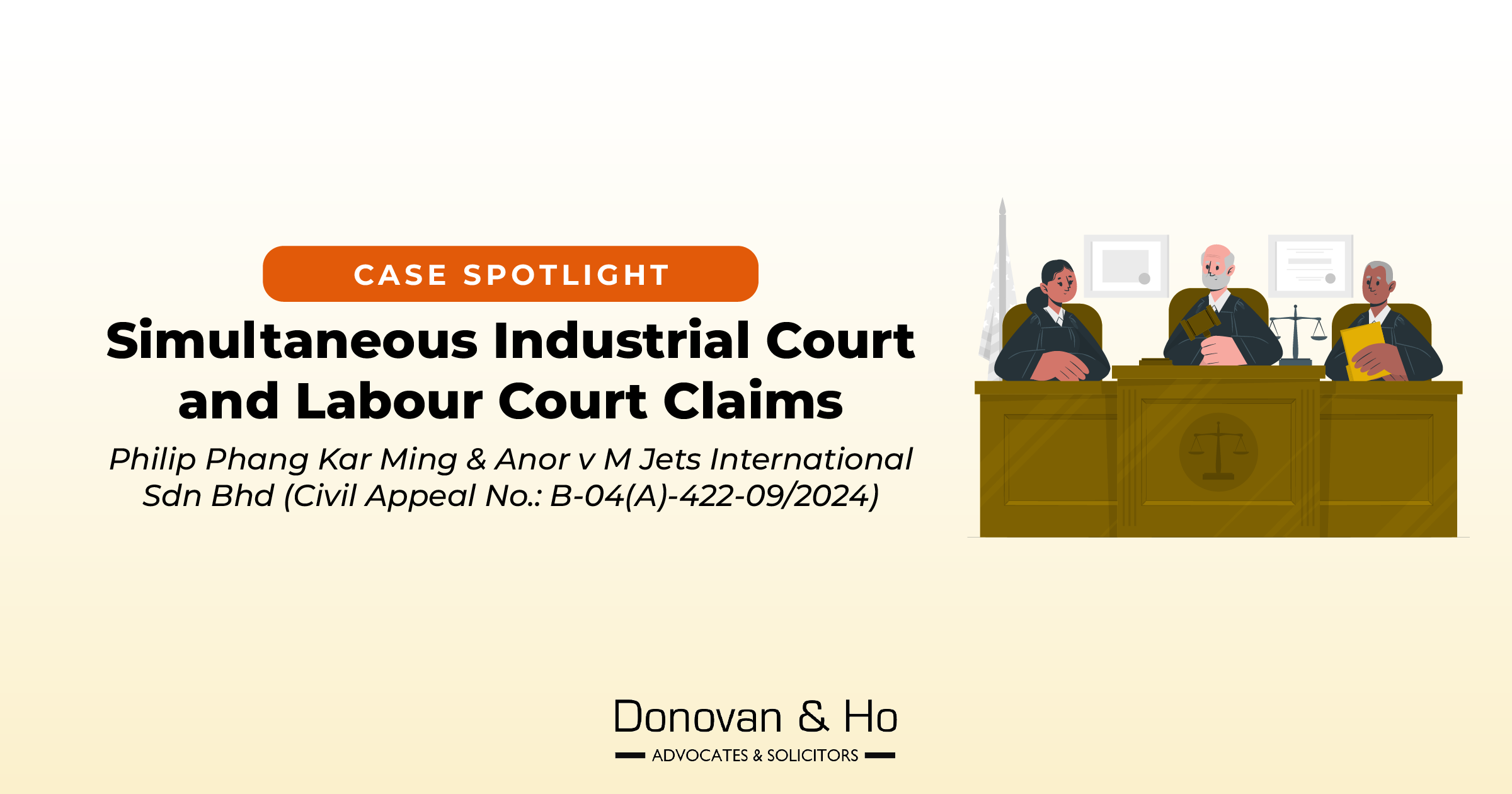
There may be overlapping employment disputes that appear to fall within the jurisdiction of both the Labour Office (colloquially known as the Labour Court) and the Industrial Court. For instance, if an employee is owed unpaid wages and has also been unfairly dismissed, can they file a wage claim in the Labour Office while pursuing an unfair dismissal claim in the Industrial Court? The Court of Appeal addressed this issue in Philip Phang Kar Ming & Anor v M Jets International Sdn Bhd (Civil Appeal No.: B-04(A)-422-09/2024).
Factual Background
- The Appellants were senior executives whose salaries were increased in 2022, later alleged by the Respondent to have been done without board approval.
- In February 2023, the Appellants were suspended by the Respondent on the grounds of alleged misconduct. Although the suspension letters stated that they would receive full salary during the suspension period, the Respondent did not pay the Appellants’ salary for February and March 2023.
- On 16 March 2023, the Appellants filed a formal complaint for unpaid wages with the Bangi Labour Office (“Wage Claim”).
- Eventually, the Appellants were terminated for misconduct on 12 April 2023 and the Appellants also filed claims for unfair dismissal.
- In August 2023, the Bangi Labour Office ruled in favour of the Appellants in respect of their Wage Claim and ordered the Respondent to pay the unpaid salaries from February 2023 to April 2023.
- Upon appeal by the Respondent to the High Court, the High Court allowed the appeal against the Wage Claim, on the basis that the Bangi Labour Office’s jurisdiction was ousted by the pending Industrial Court claim.
- The Appellants appealed to the Court of Appeal.
Court’s Findings
The Court of Appeal upheld the High Court decision and confirmed that section 69A of the Employment Act 1955 operates as a strict jurisdictional bar against a pure wage claim once an unfair dismissal claim has been filed.
Section 69A reads as follows:-
Notwithstanding section 69, the Director General [of Labour] shall not inquire into, hear, decide or make any order in respect of any claim, dispute or purported dispute which, in accordance with the Industrial Relations Act 1967-
(a) is pending in any inquiry or proceedings under that Act;
(b) has been decided upon by the Minister under subsection 20(3) of that Act; or
(c) has been referred to, or is pending in any proceedings before, the Industrial Court.
The Court emphasized that Section 69A exists to prevent duplicity of proceedings and conflicting findings. On the facts, the decision of the Labour Office would directly impact the determination by the Industrial Court on whether the salary increases were valid, whether misconduct existed, whether dismissal was with just cause or excuse and issues relating to computation of backwages.
The ouster of the Labour Office’s would prevent a duplicity of proceedings, and avoid the risk of conflicting decisions. Allowing parallel adjudication in the Labour Office and the Industrial Court on factually overlapping issues would undermine the coherence and finality of the dispute resolution process.
Key Takeaway
Given that the Industrial Court had wide remedial powers under the Industrial Relations Act 1967 (“IRA 1967”), it was the appropriate forum to decide on all interconnected issues regarding the alleged misconduct and any resultant wage entitlements. Employees should be mindful when pursuing disputes that stem from the same factual matrix, as attempts to file parallel proceedings can be set aside, causing delays and wasted resources. An early assessment of the correct forum and consolidation of related claims is crucial to avoid conflicting decisions and ensure enforceable remedies.
***
This article was written by Leow Ho Eng (Senior Associate) from Donovan & Ho’s employment law practice.
Donovan & Ho is a law firm in Malaysia, and our employment practice group has built a reputation for providing strategic employment advice to local and global organisations. Our team of employment lawyers provide advice on employment law and industrial relations including review of employment contracts, policies and handbooks, advising on workforce reductions, and managing dismissals of employees for poor performance or misconduct. We also represent clients in unfair dismissal claims and employment-related litigation.
Have a question? Please contact us.