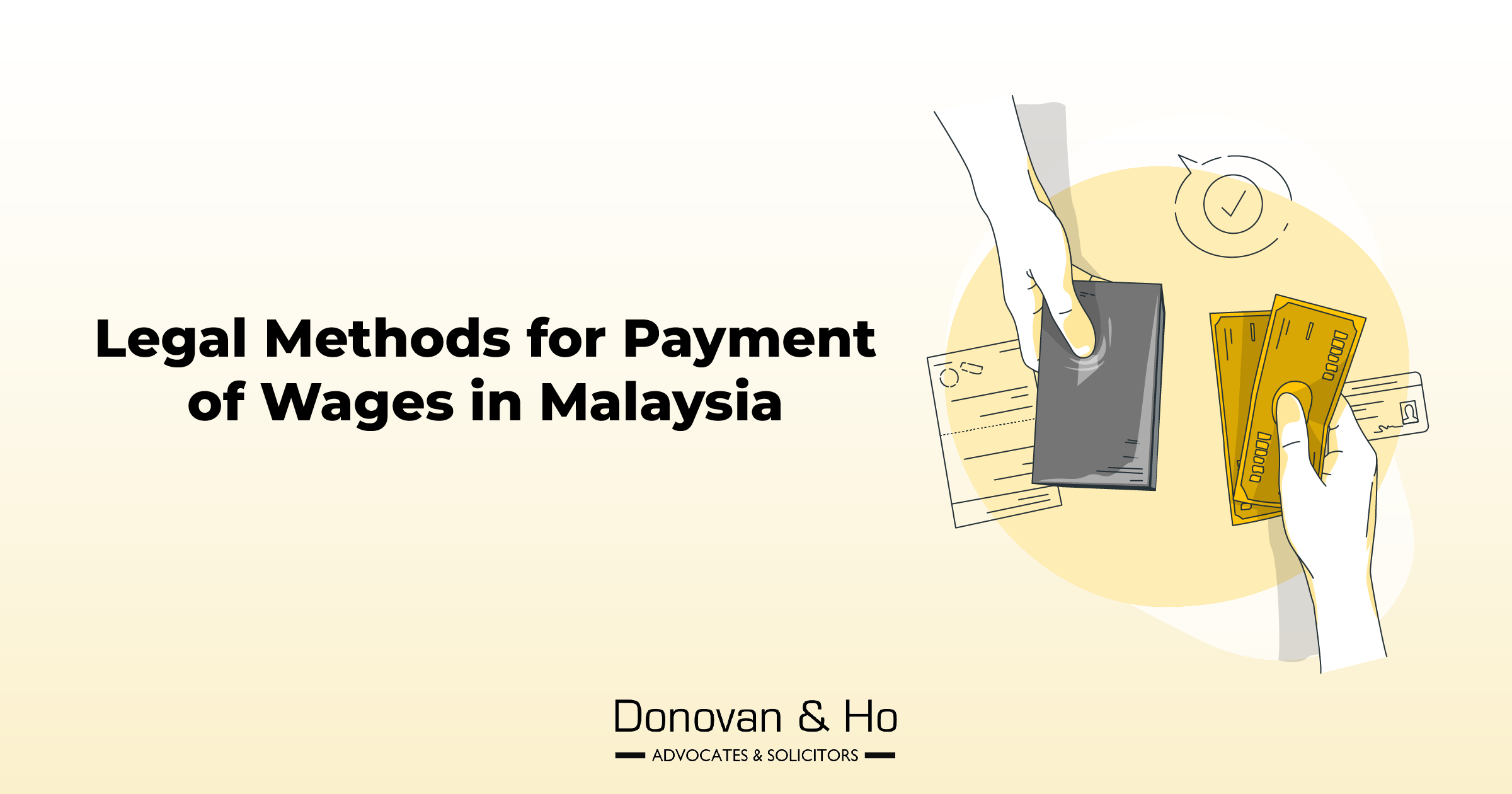
In any employment relationship, the timely and accurate payment of wages is an essential requirement. However, how wages are paid to an employee is also strictly governed by the Employment Act 1955 (“EA”). Methods for the payment of wages can be broadly categorised into three categories:
1. Financial Institutions
Under Section 25(1) of the EA, an employee’s entire wages, after lawful deductions (e.g. EPF, SOCSO, and PCB) have been made, must be paid directly into an account opened by a financial institution.
A “financial institution” is defined under Section 25(3) of the EA as:
(a) a licensed bank and an approved issuer of a designated payment instrument under the Financial Services Act 2013 [Act 758];
(b) a licensed Islamic bank and an approved issuer of a designated Islamic payment instrument under the Islamic Financial Services Act 2013 [Act 759]; and
(c) a prescribed institution under the Development Financial Institutions Act 2002 [Act 618].
The account must be in the employee’s own name, or a joint account where the employee is one of the named holders.
2. Cash or Cheque
Under Section 25A of the EA, wages may be paid in legal tender (cash) or by cheque. However, an employer cannot unilaterally decide to use these methods.
For such payments to be valid, the process must be initiated by the employee through a formal written request. The employer must then obtain official approval from the Director General of Labour, who may also impose any additional conditions deemed necessary for the approval to remain valid.
The employee retains the right to withdraw their request. To do so, the employee must provide a four-week written notice to the employer.
3. Recognised Approved Issuer
Under Section 25(4) of the EA, wages may also be paid through an approved issuer of a “designated payment instrument” or “designated Islamic payment instrument”. For this to be a legal method of payment, the approved issuer must be officially recognised by the Minister for payment of wages.
As at February 2026, these entities are approved issuers of a designated payment instrument (there is a validity period for these approvals, typically lasting for three years):
- Bayo Pay (M) Sdn Bhd.
- FINEXUS Cards Sdn Bhd.
- Merchantrade Asia Sdn Bhd.
- MobilityOne Sdn Bhd.
- TNG Digital Sdn Bhd.
- Bigpay Malaysia Sdn Bhd.
- Fass Payment Solutions Sdn. Bhd.
- IME (M) Sdn. Bhd.
- Instapay Technologies Sdn Bhd.
- Kiplepay Sdn. Bhd. Manage
- Pay Services Sdn. Bhd.
- WorkerzDirect Sdn. Bhd.
The above is set out in the Employment (Recognised Approved Issuer of a Designated Payment Instrument) Orders 2024 and 2025.
Conclusion
Employers and employees must be mindful of the legal methods for wages payment. While technology offers convenient new ways to manage payroll which can suit the specific needs of the employment relationship, the priority must be to choose a method that is legally compliant.
***
This article was written by Keanu Tan (Associate) from Donovan & Ho’s employment law practice.
Donovan & Ho is a law firm in Malaysia, and our employment practice group has built a reputation for providing strategic employment advice to local and global organisations. Our team of employment lawyers provide advice on employment law and industrial relations including review of employment contracts, policies and handbooks, advising on workforce reductions, and managing dismissals of employees for poor performance or misconduct. We also represent clients in unfair dismissal claims and employment-related litigation.
Have a question? Please contact us.