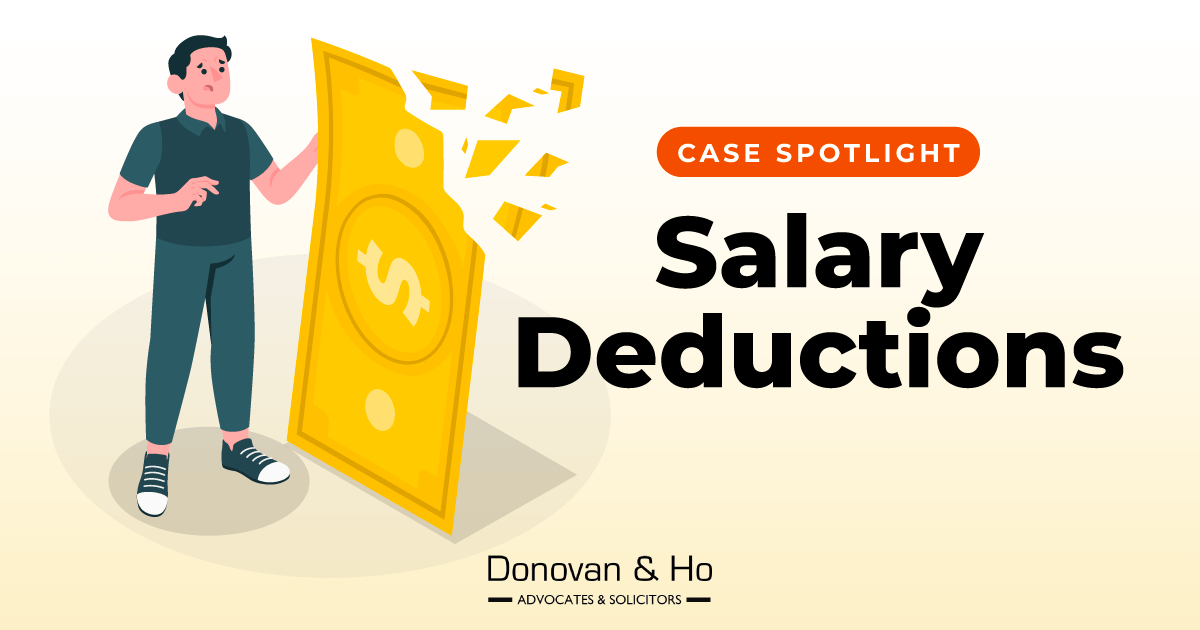
The Employment Act 1955 (“EA”) prevents employers from deducting from an employee’s wages unless allowed under the EA. A key provision to consider is Section 24, which breaks down the categories of authorised deductions into these broad categories:
- Deductions which can be made unilaterally without employee consent or request;
- Deductions which can be made only at the employee’s request in writing;
- Deductions which can be made only at the employee’s request in writing and with the prior permission in writing of the Director General of Labour; or
- Deductions which can be made only at the employee’s request in writing, and agreement of the manager of the co-operative shop.
Read our earlier article for more details on the above.
What happens when an employer and employee both agree to a deduction that does not fall within Section 24? Can mutual consent make an otherwise unlawful deduction valid?
These questions were addressed by the recent High Court case of Lim Hwa Tian v Simple Farm Sdn Bhd [2024] CLJU 1146.
Background Facts
- The employee claimed that a sum of RM500.00 was unlawfully deducted from his monthly salary for 32 months (May 2019 until December 2021) by the employer.
- The employer said these deductions were to recover the sum of RM157,938.00 from the employee, purportedly arising from the employee’s misappropriation of monies from cash payments made by customers.
- The employer alleged these deductions were based on mutual trust and verbal agreement between both parties, whereby the employee agreed to a monthly deduction of RM500.00 from his salary.
- The employee’s salary slip denoted the deductions as being for “advances”. The employer argued these are lawful deductions under section 24(2) which allows deductions to be made for the ‘recovery of advances of wages’.
- The Labour Court dismissed the employee’s claim because the employee agreed to the monthly deduction of RM500.00.
- The employee appealed to the High Court.
Court’s Findings
The High Court allowed the employee’s appeal and overturned the Labour Court’s decision. The High Court held:
- The deductions were for repayment of monies collected from the employer’s customers but not forwarded to the employer. There was no evidence that these were deductions for advance of wages.
- The Labour Court had misdirected itself by failing to consider whether the deductions were lawful within the meaning of section 24 of the EA and adopted a simple approach that the deductions were agreed upon by both parties.
- The Labour Court failed to see the important point that in the first place, the deductions must be lawful as per section 24 of the EA, and parties are not entitled to waive this requirement.
- The decision in Mercury Industries Berhad v Ng Poi Kuan [2022] CLJU 1897 relied on by the employer did not apply to the facts of this case. In the Mercury Industries Berhad case, the salary reduction was made with the consent of the employee during the COVID -19 pandemic and the imposition of the Movement Control Order.
- If the employee owed the employer a sum of RM157,938.00, then the employer’s remedy lies in a civil action against the employee and not through salary deductions.
Key Takeaways
Employers cannot deduct wages unless the reason for the deduction falls squarely within Section 24 of the Employment Act. This applies even if the employee has agreed to the deduction. Mutual consent does not validate a deduction that the law does not permit. If the employee later reneges on their agreement, the employer may still be found to have made an unlawful deduction and may have to refund the amounts taken.
If an employee genuinely owes money to the employer, the proper recourse is through a separate legal action or repayment arrangement, not through unauthorised salary deductions.
That said, Section 24 EA applies only to deductions from “wages”. Employers may make deductions from other payment components that do not fall within the definition of wages, if the employee consents and the agreement is properly documented.
***
This article was written by Keanu Tan (Associate) from Donovan & Ho’s employment law practice.
Donovan & Ho is a law firm in Malaysia, and our employment practice group has built a reputation for providing strategic employment advice to local and global organisations. Our team of employment lawyers provide advice on employment law and industrial relations including review of employment contracts, policies and handbooks, advising on workforce reductions, and managing dismissals of employees for poor performance or misconduct. We also represent clients in unfair dismissal claims and employment-related litigation.
Have a question? Please contact us.