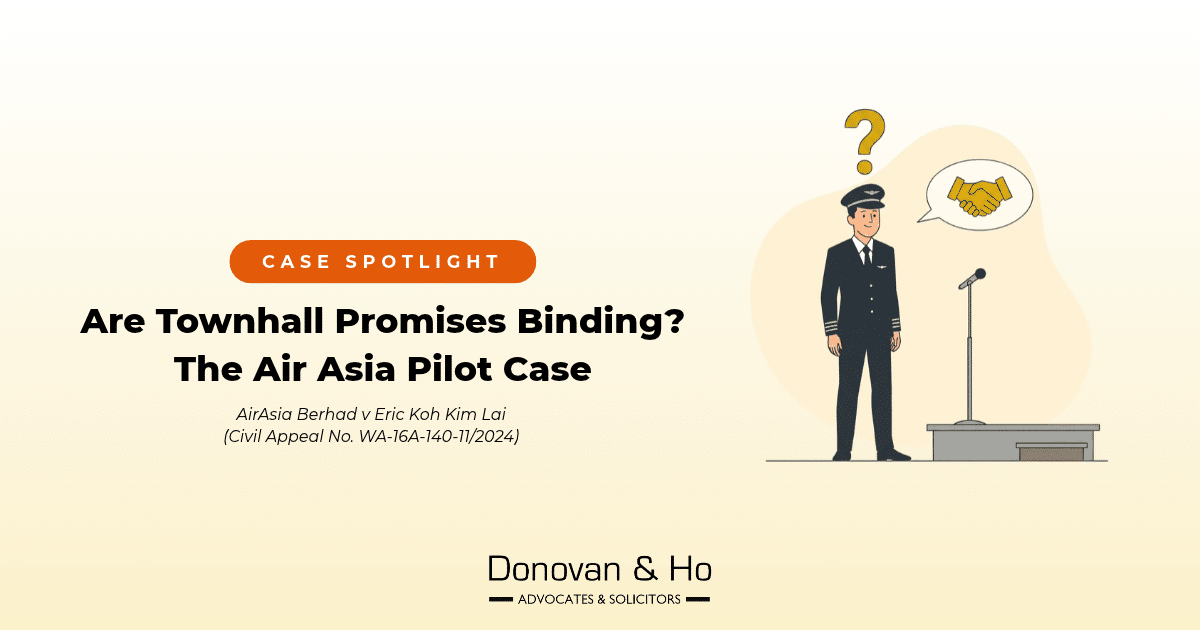
Can an employer’s town hall promises become legally binding? And can financial difficulties justify going back on them?
In AirAsia Berhad v Eric Koh Kim Lai (Civil Appeal No. WA-16A-140-11/2024), the High Court considered whether AirAsia’s unpaid leave and furlough arrangements, together with its assurances to a pilot, could form a basis to a constructive dismissal claim. The case highlights the legal significance of promises to employees and whether financial difficulties can justify departing from them.
Brief Facts
- The Claimant was employed as a pilot with AirAsia.
- 6.10.2020 – AirAsia imposed 15 days of unpaid leave per month on pilots, significantly reducing their salaries.
- 1.1.2021 to 31.3.2021 – AirAsia placed pilots on furlough as part of its COVID-19 cost-cutting measures.
- 1.3.2021 to 31.12.2021 – AirAsia imposed further furloughs amid continuing pandemic-related challenges.
- 25.11.2021 – During a town hall meeting (“November 2021 Townhall”), AirAsia proposed permanently reducing pilots’ salaries, by 15% in the Claimant’s case. In exchange, AirAsia assured the pilots, including the Claimant, that it would reactivate their service in 2022 and impose no further unpaid leave afterwards.
- Relying on these assurances, and fearing repercussions, the Claimant signed a second employment contract providing for the permanent salary reduction.
- 8.4.2022 – At another town hall meeting, the Claimant was told he would remain on indefinite unpaid leave, even after reactivation.
- 27.4.2022 – The Claimant resigned, citing breach of the November 2021 Townhall promises, the unpaid leave schemes and the multiple furloughs.
- The Industrial Court held that the Claimant had been constructively dismissed and ordered AirAsia to pay RM 268,620.00 in back wages and compensation in lieu of reinstatement.
- AirAsia appealed to the High Court.
Court’s Findings
The High Court dismissed AirAsia’s appeal and affirmed the Industrial Court’s decision. The High Court held that:
- Town hall assurances can carry legal significance – The Court found that AirAsia’s assurances at the November 2021 Townhall were not merely aspirational statements or “mere puffs”. They were relevant to assessing whether AirAsia’s later decision to place the Claimant on indefinite unpaid leave was consistent with what it had represented to the pilots.
- Unilateral changes to fundamental contractual terms are a breach – AirAsia had no contractual right to impose indefinite unpaid leave without a sufficiently definite return-to-work date.
- Operational uncertainty is not a justification – AirAsia could not rely on uncertainty over its future operational needs to justify departing from its contractual obligations in the employment contract and also through the November 2021 Townhall representations.
- Consent to temporary measures is not indefinite consent – The Claimant’s consent to temporary measures in exceptional circumstances like the pandemic, was not consent to an indefinite deprivation of remuneration and suspension of his contractual obligation to work.
- Non-payment of contractual wages is a fundamental breach – The Claimant’s entitlement to wages did not depend on his being assigned flights or being reactivated. The contract did not allow AirAsia to reduce his wages unilaterally, and its obligation to pay wages applied regardless of its financial circumstances.
- Unauthorised salary deductions – The Court upheld the Industrial Court’s finding that the Claimant, as a pilot operating an aircraft used to transport passengers, fell within the scope of section 2(2) of the Employment Act 1955 (pre amendments). Section 24(8) therefore applied to the deductions made through AirAsia’s unpaid leave arrangements, and the salary deductions made by AirAsia were contrary to law.
Key Takeaways
Employers must carefully consider their contractual obligations and representations to employees before changing employment arrangements.
A practical point for employers is to ensure that assurances made to employees are consistent with subsequent actions. Although townhalls may seem more casual than written policies or communications, representations made during such town halls may carry legal significance, particularly where employees rely on them in agreeing to changes to their employment terms.
Similarly, employers should not assume that an employee’s consent to temporary measures is indefinite, and can be extended as such. Operational challenges should not lead to unilateral changes to fundamental employment terms or non-payment of contractual wages. Any unpaid leave, furlough arrangements and salary deductions (even if mutually agreed) should be checked for legal compliance before implementation.
Note: The Claimant was successful at both the Industrial Court and at the High Court Appeal. As at the time of writing, Air Asia’s appeal to the Court of Appeal is pending.
***
This article was written by Leow Ho Eng (Senior Associate) from Donovan & Ho’s employment law practice.
Donovan & Ho is a law firm in Malaysia, and our employment practice group has built a reputation for providing strategic employment advice to local and global organisations. Our team of employment lawyers provide advice on employment law and industrial relations including review of employment contracts, policies and handbooks, advising on workforce reductions, and managing dismissals of employees for poor performance or misconduct. We also represent clients in unfair dismissal claims and employment-related litigation.
Have a question? Please contact us.