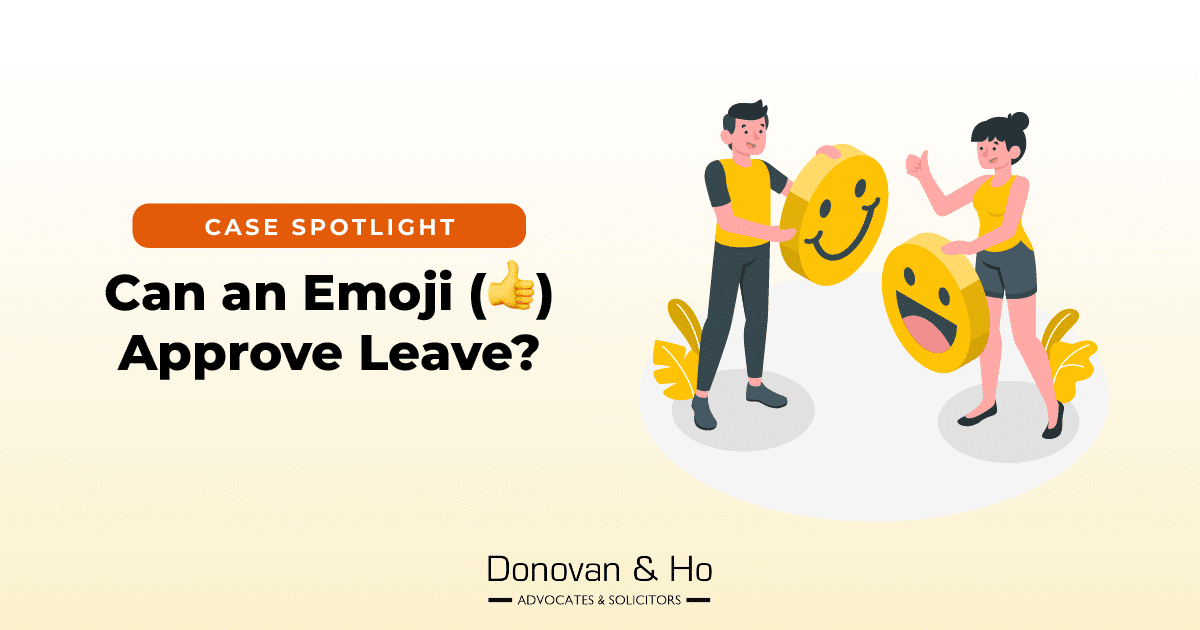
What happens when a manager uses an “OK” or thumbs up 👍 emoji on Whatsapp to respond to a leave application? Does this amount to an official approval?
The Industrial Court in IMMA v Wellnesspreneur Group Sdn Bhd explored whether an employee’s reliance on informal messaging justifies a month-long absence from work and the legal consequences of abandonment.
Brief Facts
- In early 2024, the Claimant applied for one month of unpaid leave via the Company’s WhatsApp group.
- The Claimant alleged that the Director responded to her request with an “OK” hand emoji (👍), which she interpreted as formal approval.
- The Company issued a formal letter on 21 February 2024 rejecting the leave application due to an insufficient leave balance.
- Despite the formal rejection, the Claimant proceeded to be absent from work starting from 1 March 2024.
- The Company issued a letter requiring the Claimant to explain her absence, but she failed to provide any explanation.
- The Company subsequently terminated the Claimant on 11 March 2024 for misconduct and abandonment of duties.
Court’s Findings
The Court found that an emoji in a WhatsApp conversation cannot be reasonably construed as formal leave approval. At most, such a symbol indicates that the Director acknowledged receipt of the message. It does not satisfy the requirement for formal written approval as dictated by Company policy.
Significant inconsistencies were also noted in the Claimant’s pleadings and testimony. The Claimant cited dates for her leave applications that were chronologically impossible, which severely undermined her overall credibility. She failed to call a key witness to support her claim that a manager had earlier approved her leave.
The Court determined that the Claimant’s continuous absence for several days without approval amounted to abandonment of employment. By being absent from work for such a long period without permission, the Claimant repudiated her contract, and the Company was legally entitled to treat the employment as terminated.
Key Takeaways
Employers should ensure that all leave approvals are documented through formal channels and supported by written records, in accordance with the procedures set out in the company handbook. This means that requests for leave should be submitted through the designated systems such as the company’s HR portal, official leave forms, or email correspondence, rather than through informal messaging platforms or verbal conversations. The approval or rejection of such leave should likewise be recorded in writing by the relevant supervisor or HR personnel. A well-documented approval process can therefore play a critical role in mitigating misunderstandings and strengthening the employer’s position in the event of disciplinary proceedings or employment-related claims.
Managers should also exercise caution when using emojis or overly informal language in work-related communications, as these may create ambiguity or unintended interpretations. Employees should obtain clear and formal permission before proceeding on leave, and where there is a formal written rejection, this will take precedence over any verbal or informal approval.
***
This article was written by Donovan Cheah (Partner) from Donovan & Ho’s employment law practice.
Donovan & Ho is a law firm in Malaysia, and our employment practice group has built a reputation for providing strategic employment advice to local and global organisations. Our team of employment lawyers provide advice on employment law and industrial relations including review of employment contracts, policies and handbooks, advising on workforce reductions, and managing dismissals of employees for poor performance or misconduct. We also represent clients in unfair dismissal claims and employment-related litigation.
Have a question? Please contact us.