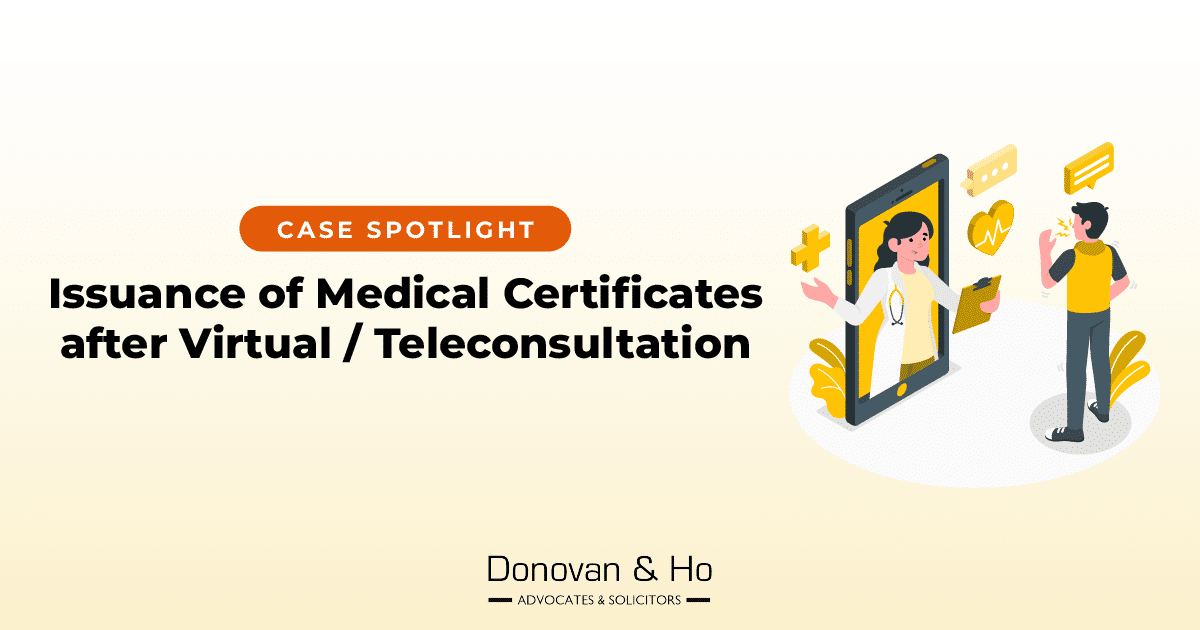
The Malaysian Medical Council (“MMC”) Ethics Committee published a notification dated 23 September 2025 clarifying that a medical certificate (“MC”) cannot be issued solely following a virtual consultation (teleconsultation).
While the directive is addressed to registered medical practitioners, employers should take note given that it may be relevant to how statutory sick leave is managed.
MMC’s Position on Issuance of MCs
The MMC has reiterated that an MC should only be issued after an appropriate consultation, which includes:
- history taking;
- physical examination; and
- investigations where necessary.
The MMC stated that the issuance of an MC solely based on teleconsultation / virtual consultation is not allowed.
Failure to comply with this directive may result in disciplinary proceedings against the registered medical practitioner.
Statutory Sick Leave under the Employment Act 1955
Under Section 60F of the Employment Act 1955 (“EA”), employees are entitled to paid sick leave where they are certified to be ill by a registered medical practitioner.
The EA does not prescribe any specific requirements regarding how the medical practitioner must conduct the consultation before issuing the MC.
However, it may reasonably be presumed that the certification contemplated under Section 60F must be one issued in accordance with the applicable professional standards and requirements governing medical practitioners.
Managing Validity of Teleconsultation MCs
Many healthcare providers have adopted telemedicine practices during and after the COVID-19 pandemic.
However, employers presented with an MC will not know whether the certificate was issued following a virtual consultation or after a physical examination, unless this is expressly indicated on the MC itself (which is unlikely).
Where employers want to reject MCs issued solely pursuant to teleconsultation in line with the MMC’s position, they may want to review and update their sick leave policies to ensure alignment with current professional medical standards, and educate their employees about this requirement.
At the same time, HR departments should exercise caution before rejecting an MC outright, as an improper denial of sick leave may expose the employer to potential claims or disputes.
Disciplinary Considerations
In cases involving suspected abuse of MCs, employers must still comply with principles of procedural fairness.
Employees may not be aware of the MMC’s decision and may genuinely believe that an MC issued following a teleconsultation is valid, since it is issued by a registered medical practitioner.
If employers do not intend to recognise such MCs, this should be clearly stated in internal policies together with the rationale (i.e.: that because the MMC does not recognise or allow MCs based on teleconsultation). An employee who subsequently obtains an MC purely from a virtual consultation in breach of a clearly communicated policy may then be found to have violated company rules.
Conclusion
The MMC’s position does not mean that teleconsultations themselves cannot be conducted. Virtual consultations may still serve practical purposes, such as reducing unnecessary clinic visits and facilitating access to medical advice. The MMC’s position is simply that the certification that a patient is unfit for work should generally only be issued after an appropriate physical examination.
As digital healthcare continues to evolve, employers should ensure that their workplace policies remain aligned with prevailing professional medical standards while balancing practical considerations in the administration of sick leave.
***
This article was written by Nalina Santhiran (Associate) from Donovan & Ho’s employment law practice.
Donovan & Ho is a law firm in Malaysia, and our employment practice group has built a reputation for providing strategic employment advice to local and global organisations. Our team of employment lawyers provide advice on employment law and industrial relations including review of employment contracts, policies and handbooks, advising on workforce reductions, and managing dismissals of employees for poor performance or misconduct. We also represent clients in unfair dismissal claims and employment-related litigation.
Have a question? Please contact us.