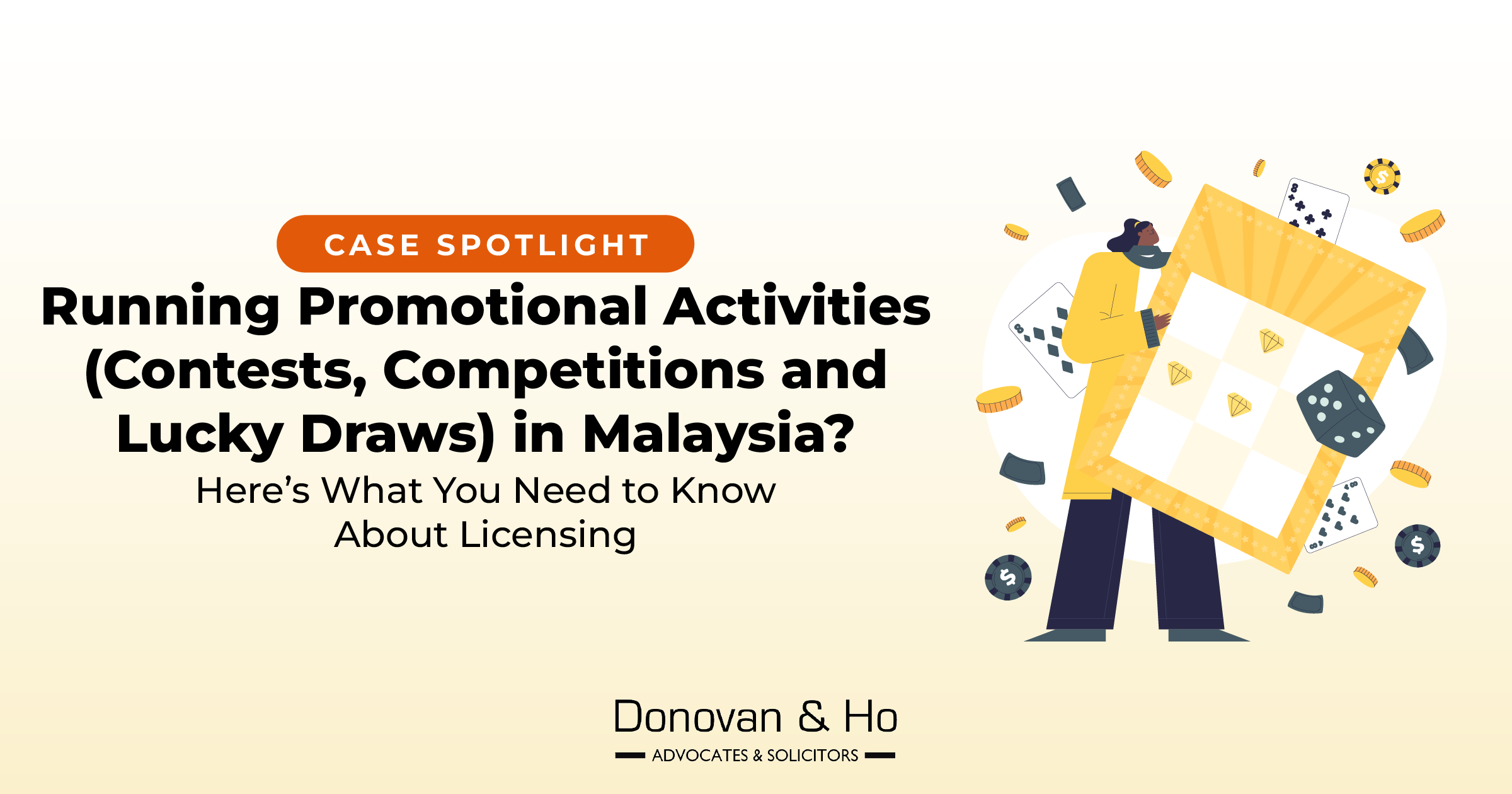
Promotional campaigns such as contests, competitions, and lucky draws (collectively, “Promotional Activities”) are widely used by businesses in Malaysia to drive sales, increase engagement, and enhance brand visibility.
However, these campaigns may inadvertently fall within the scope of Malaysian gaming laws if not carefully structured. This article provides an overview of the legal framework governing such Promotional Activities, the licensing position, and practical considerations for businesses.
General Legal Position
Promotional Activities that involve an element of chance are primarily governed by the Common Gaming Houses Act 1953 (“CGHA”) and the Lotteries Act 1952 (“MLA”). Broadly, a Promotional Activity may be considered “gaming” or a “lottery” where:
- Chance is involved (wholly or partly); and
- There is a prize of money or money’s worth.
This means that even where chance is only one component (and not the sole determinant), the activity may still fall within the definition. Common examples that may trigger gaming laws:
- Lucky draws;
- Spin-the-wheel mechanics;
- Mystery prize;
- Randomised digital rewards;
- Blind box / mystery box rewards (where outcomes are randomised); or
- Randomised cashback or voucher drops (e.g. “shake to win” or “tap to reveal” features).
Modern marketing strategies increasingly blur the line between engagement and gaming, particularly with the rise of gamification in e-commerce and digital platforms. In particular, blind box mechanics—now widely used in retail, collectibles, and online marketplaces—may raise legal concerns where consumers effectively pay for a chance to obtain higher-value or rare items.
Similarly, many online and app-based campaigns now use features such as mini games, “scratch and win” cards, or “spin for a deal” promotions commonly seen on e-commerce platforms. While these features are designed to increase user engagement, they often involve an element of chance in determining the reward.
Even where these campaigns are framed as marketing or loyalty features, if the outcome depends on luck rather than skill and there is prize of money or money’s worth, they may still carry legal risk under Malaysian gaming laws.
For further information, please refer to our previous article,
Licensing / Permit Requirements
- Licences under the CGHA: Under Section 27A of the CGHA, the Ministry of Finance has discretion to grant licenses for gaming activities. However, in practice, such licenses are highly restricted, typically reserved for gambling operators.
- Permits under the MLA: Under Section 4 of the MLA, the Ministry of Finance has the discretion to issue permits to any person or society to promote lottery for the purpose of raising funds to be applied for charitable purposes only such as:
i) Philanthropic;
ii) Religious;
iii) Educational; or
iv) Welfare-related causes.
Additionally, Section 5 of the MLA imposes 2 strict conditions on the permits, namely that: (i) no individual may profit from the lottery; and that (ii) all proceeds (after approved expenses) must be applied to the stated charitable purpose.
Consumer Protection
In addition to gaming laws, Promotional Activities are subject to the Trade Descriptions Act 2011 (“TDA”), particularly Section 20 of the TDA, which prohibits false or misleading statements in relation to contests, games, and similar activities.
Falsely representing that goods or services offered are able to facilitate winning in any contest or game of chance or falsely representing that a person has won or will win a prize through the purchase of goods or services when, in reality, the prize does not exist or requires unreasonable conditions to claim is prohibited. Using catchy slogans to attract consumers under false pretences may constitute an abuse of promotional tactics.
Implications on Businesses
- Penalties for Non‑Compliance: Under the CGHA, holding or promoting gaming activities without the necessary licences or permits may result in a fine of not less than RM5,000 and not more than RM50,000, and may also be punishable with imprisonment for a term not exceeding 3 years. As for promoting a lottery without a permit or in contravention of the conditions of a permit, the MLA provides that such offences are punishable with imprisonment for a term not exceeding 3 years, or a fine not exceeding RM10,000, or both. Non-compliance with the TDA may also result in companies being fined up to RM500,000 for a first violation or RM1,000,000 for a subsequent offence.
- Structuring Campaign: Businesses should structure campaigns to avoid chance-based outcomes or obtain the required licenses or permits.
- Clear Terms and Conditions: Well-drafted Terms & Conditions are essential for compliance and dispute mitigation. Key clauses should include eligibility criteria; winner selection methodology, prize details and limitations; and publicity and consent provisions.
Conclusion
While Promotional Activities are powerful marketing tools, Malaysian law adopts a restrictive approach toward chance-based mechanics, particularly where commercial gain is involved.
With the rise of gamified marketing strategies, including blind boxes and digital reward systems, businesses must exercise heightened caution.
***
This article was written by Low Rui Thong (Associate) with assistance from Wong Pro Sam (Intern) from Donovan & Ho’s corporate practice.
Our corporate practice group advises on corporate acquisitions, restructuring exercises, joint venture arrangements, shareholder agreements, employee share options and franchise businesses, Malaysia start-up founders and can assist with venture capital funds in Seed, Series A & B funding rounds. Feel free to contact us if you have any queries.