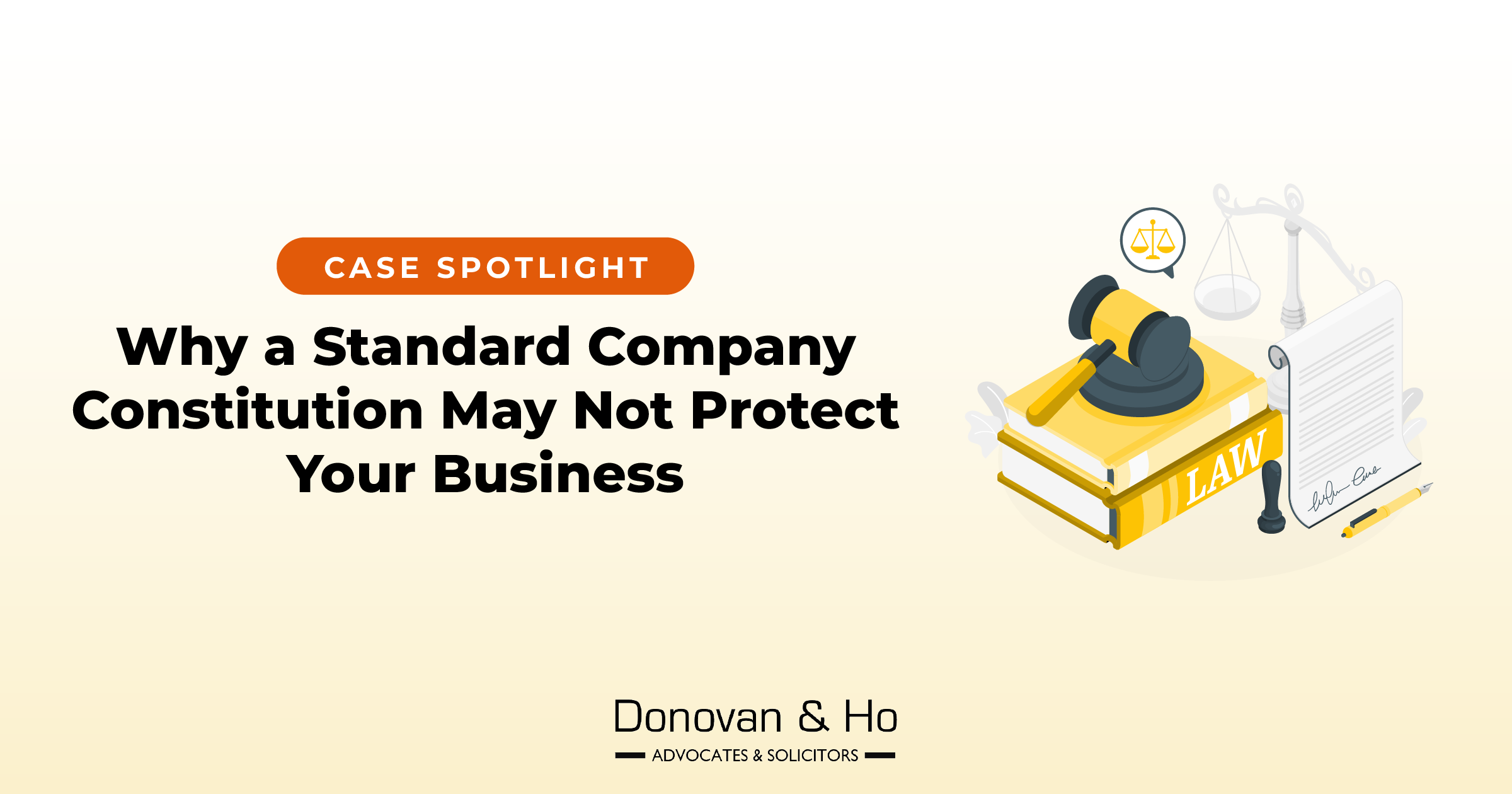
Many business owners in Malaysia adopt a template or “standard” constitution when incorporating their company because it is fast, inexpensive, and readily available through incorporation agents or online platforms. In many cases, founders are told that the template is “sufficient.”
From a regulatory perspective, this may be true if the template satisfies minimum legal requirements under the Companies Act 2016. However, what is often misunderstood is that compliance does not equate to protection.
A template constitution is designed to meet statutory formalities, not to address the specific commercial realities, risks, and relationships between founders, shareholders, and potential future investors. As the business grows, this gap between actual operations, compliance and protection becomes increasingly significant.
Lack of Flexibility in Passing Board Written Resolutions
A standard company Constitution may not fully address the practical needs of a business, particularly with respect to passing board resolutions in writing. Under the Companies Act 2016, the default rule under Paragraph 15 of the Third Schedule requires that directors’ written resolutions be approved by unanimous consent of all directors entitled to receive notice of the meeting of the board.
For companies with larger boards, directors who travel frequently, or decisions that are time-sensitive, this unanimous requirement can be impractical. A single unavailable or unreachable director can delay or block a resolution, even when all other directors are in agreement.
By customizing the constitution, companies can introduce more practical arrangements. For example, a written resolution could be valid if approved by a simple majority. This change provides greater flexibility and efficiency, allowing timely decision-making without the need for a physical or virtual meeting, while still ensuring proper corporate governance.
Lack of Clarity on Shareholder Rights
One of the most common problems arising from template constitutions is the lack of clarity regarding shareholder rights and decision-making authority. In the early stages of a business, founders often operate based on trust and informal understanding. However, as the company expands, disagreements over strategy, financial management, expansion plans, or reinvestment of profits may arise. A template constitution typically does not specify which decisions require unanimous consent, which require a simple majority, or whether certain shareholders have special approval or veto rights.
Without this clarity, disputes can quickly escalate because each party may interpret their rights differently. This uncertainty not only damages working relationships but also creates legal and operational risk, as decisions made without proper authority may later be challenged.
Deadlock Situations
Deadlock situations present another serious risk, particularly in companies with equal 50:50 shareholding structures, which are very common among small and medium enterprises founders. Deadlock occurs when shareholders or directors are unable to agree on critical matters, such as entering into new business ventures, raising financing, appointing key management, or approving major expenditures.
Template constitutions rarely include mechanisms to resolve such deadlocks, such as share buyback provisions or forced exit options. Without these mechanisms, the company may be unable to make decisions or move forward. This can result financial losses and in some cases, costly litigation between shareholders.
Potential Challenges with Non-Cooperative Shareholders or Directors
Another potential risk is the difficulty in dealing with non-cooperative shareholders or directors. Business relationships evolve over time, and it is not uncommon for one shareholder to pursue competing interests or engage in conduct that is detrimental to the company. In other situations, personal disagreements between founders can make ongoing collaboration difficult.
Template constitutions rarely provide clear and practical mechanisms for removing such individuals or facilitating an orderly exit. Without properly drafted provisions addressing compulsory transfers, exit triggers, or valuation mechanisms, the remaining shareholders may have no effective way to resolve the situation which may potentially impact the growth of the company.
Key Takeaways
A constitution that is carefully tailored to the company’s structure and needs can provide clarity on shareholder rights and decision-making, address deadlock and exit scenarios, and accommodate future business developments, thereby reducing disputes and operational risks while supporting fundraising, restructuring, and long-term growth and investment readiness.
***
This article was written by Jocelyn Lier (Associate) from Donovan & Ho’s corporate practice.
Our corporate practice group advises on corporate acquisitions, restructuring exercises, joint venture arrangements, shareholder agreements, employee share options and franchise businesses, Malaysia start-up founders and can assist with venture capital funds in Seed, Series A & B funding rounds. Feel free to contact us if you have any queries.