Can an employer dismiss an employee simply because the employee’s personal account was used for wrongdoing, without proving that the employee did it or was negligent?
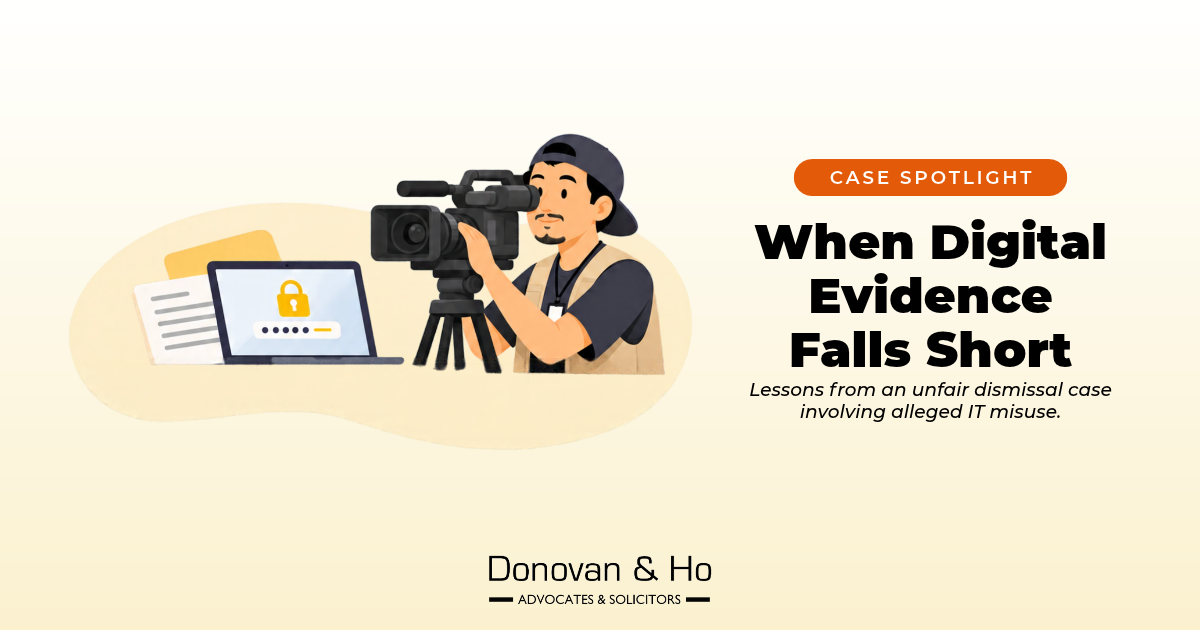
On 13 November 2026, the Kuala Lumpur Industrial Court addressed this question in CKT v Astro Facilities Sdn Bhd, where Astro dismissed a cameraman with 26 years of service over alleged IT misuse: the illegal streaming of Astro content through his personal AstroGo account into an unlicensed app.
The Court scrutinised the domestic inquiry, exposed gaps in the Company’s investigation, and refused to accept “the account was his” as proof of misconduct. It found the dismissal was without just cause or excuse and awarded him RM474,240.
Brief Facts
- The Claimant had 26 years of continuous service and no known disciplinary record.
- In March 2023, the Company’s Anti-Piracy Technology team detected its Astro Ceria content on an unlicensed streaming application, HotTV, and traced the stream to the Claimant’s personal AstroGo account, which was registered with his work email.
- The Company charged the Claimant with intentionally and/or negligently abusing his AstroGo account to illegally stream Astro Ceria into HotTV, in breach of the Company’s Code of Business Ethics. The charge also cited section 43AA(2) of the Copyright Act 1987 (a criminal offence).
- The Claimant denied involvement, saying he was at home on his day off (as his wife confirmed) and that his son was at work in Kuala Lumpur at the time and so could not have been responsible either. He also suggested that someone may have misused his account.
- A domestic inquiry found him guilty, and the Company dismissed him on 24.7.2023.
- The police investigation was still ongoing at the time of the inquiry. The police later found no evidence linking the Claimant’s or his family’s devices to the streaming.
- The Claimant challenged his dismissal before the Industrial Court.
Court’s Findings
The Industrial Court held that the Company had failed to prove the misconduct on the balance of probabilities, so the dismissal was without just cause or excuse. The Court highlighted some shortcomings: no forensic examination of the relevant devices was conducted, the evidence was speculative and failed to establish the Claimant’s responsibility, and the domestic inquiry wrongly shifted the burden of proof onto the Claimant.
In particular:
- It was not seriously disputed that the stream ran through the Claimant’s account, but the Court held that this alone was not enough: “more is needed” to prove intention or negligence.
- Holding the Claimant responsible because his account was used imposed an “unfair and unjust strict liability” on him. Nor did the Company lead convincing evidence of a breach of duty of care to establish negligence.
- The Company’s witness speculated that the Claimant’s wife or son could have done it if given the mobile OTP. The Court found this was conjecture without evidence, and that the domestic inquiry had wrongly shifted the burden of proof onto the Claimant to prove his innocence.
- The Company relied on “dark web” searches that purportedly showed no evidence that the Claimant’s account credentials were leaked. However, the Court found this to be inconclusive and unexplained, given that the Company did not forensically examine the devices of the Claimant or his family. The Company’s witnesses were also unable to explain how the dark web searches were carried out.
- The Court also noted that for the criminal charge under the Copyright Act 1987, the Claimant was eventually acquitted without being called to enter his defence, and the High Court dismissed the prosecution’s appeal. The Court criticised the Company for including a criminal charge under the Copyright Act in the domestic inquiry notice, describing this as the “exclusive domain of the Public Prosecutor” and a sign of haste. It saw no reason for including it other than to intimidate the Claimant into admitting the illegal streaming.
- The domestic inquiry panel itself found the case “challenging” on the facts and acknowledged that the police outcome was needed, yet still found the Claimant guilty. The Court said the Company proceeded with no credible evidence.
- The Court awarded 22 months’ back wages (reduced from the 24-month cap to account for his post-dismissal earnings) and compensation in lieu of reinstatement of one month’s wages for each of his 26 years of service, totalling RM474,240.
Key Takeaways
The Court did not fault the domestic inquiry itself, since it let the Claimant defend himself in line with natural justice. It viewed the problem was with how the Company and the panel treated the evidence. The key takeaway is that the employer bears the burden of proving that the dismissal was with just cause or excuse. The employee need not prove his innocence, or that the dismissal was unfair.
Three practical lessons for employers emerge:
- Preserve and forensically examine relevant evidence before issuing charges
Where applicable, especially for IT misconduct, employers should secure and forensically examine the relevant devices and systems before issuing charges. The Company did not forensically check the Claimant’s or his family’s devices, and its witnesses could not explain how it conducted the dark web search. The Court therefore described the resulting conclusions as ‘unsupported’. - Be satisfied there is enough evidence to establish the misconduct before taking disciplinary action
In this case, the Company’s evidence fell short. Its witness’s theory that the Claimant’s wife or son could have used the account was held to be conjecture with no supporting evidence. For IT misconduct cases, proof that an account was used may be where an investigation starts, not where it ends. - Ensure any dismissal is proportionate to the misconduct
Dismissal is the most serious sanction available. Before imposing it, employers should weigh the misconduct and the strength of the evidence against the employee’s length of service and disciplinary record. Here, the Claimant had 26 years of service and no known disciplinary record.
***
This article was written by Juhi Vora (Associate) from Donovan & Ho’s employment law practice.
Donovan & Ho is a law firm in Malaysia, and our employment practice group has built a reputation for providing strategic employment advice to local and global organisations. Our team of employment lawyers provide advice on employment law and industrial relations including review of employment contracts, policies and handbooks, advising on workforce reductions, and managing dismissals of employees for poor performance or misconduct. We also represent clients in unfair dismissal claims and employment-related litigation.
Have a question? Please contact us.