We previously wrote about the Court of Appeal’s decision in Woon Kim Choy v. Acexide Technology Sdn Bhd & Anor and Another Appeal [2025] 2 CLJ 57, holding that a director removed from the Board is not automatically dismissed as an employee, and that the two respondents were “workmen” who could claim unfair dismissal.
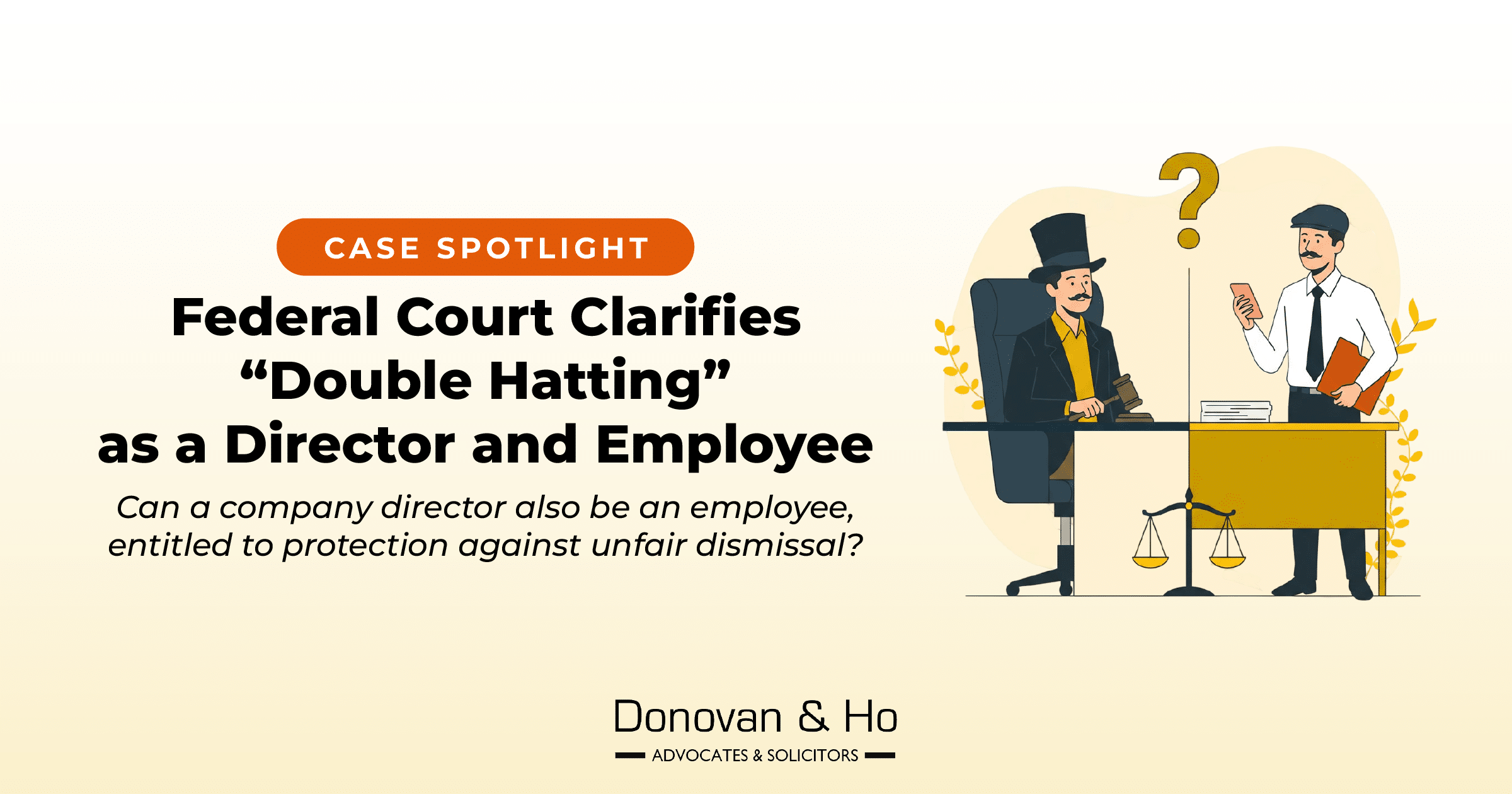
The company appealed to the Federal Court. In Acexide Technology Sdn Bhd & Anor v. Chang Heng Keong & Another Appeal [2026] CLJU 2221, the apex court unanimously dismissed the appeals and affirmed that decision in full. It went further, however, in explaining how the two positions can coexist in one individual, a concept it termed “double hatting”. That gives employers a clearer framework for when the arrangement attracts protection under the Industrial Relations Act 1967 (“IRA 1967”).
Salient Facts
Mr Woon and Mr Chang were, with Mr Lim, the three promoters, shareholders and directors of the company, holding the functional titles of technical director and project director respectively. In November 2019, an extraordinary general meeting convened at Mr Lim’s behest removed them as directors, with the minutes recording that they were discharged of all their duties and that the company would stop paying their “salaries”. They then filed a section 20 reference with the Director General of Industrial Relations, alleging unlawful dismissal as “workmen”.
The Industrial Court and High Court held that they were not “workmen” but the “directing mind and will” of the company. The Court of Appeal reversed, finding that directors can simultaneously be “workmen”, and awarded compensation in lieu of reinstatement plus back wages. The company obtained leave to appeal on 11 questions of law, the central one being whether the respondents, as directors, could also be “workmen”.
Federal Court’s Findings
The “Double Hatting” Concept
The Federal Court agreed with the Court of Appeal but clarified the conceptual basis. The position of a director (governed by the Companies Act 2016 and fiduciary duties) and that of an employee (governed by a contract of employment and labour law) remain, in law, mutually exclusive: a director, as director, is not an employee, and vice versa. As the court put it, “it is the individual – not the position of director – who can double hat and perform both roles”. The roles stay distinct, but nothing prevents them from coexisting in the same person.
The Board, Not a Single Superior, Is What Matters
The company argued that as equal, co-deciding directors with no one to report to, the respondents could not satisfy the superior-subordinate relationship needed for “workman” status. The Federal Court rejected this. Each was individually answerable to the Board as a whole, not to any single co-director, and equally answerable to the Board for their day-to-day functional roles. Either way, a superior-subordinate relationship existed.
A Different Form of Control for Senior Executives
The Federal Court endorsed the Court of Appeal’s observation that the traditional “degree of control” test (fixed hours, clocking in, leave approval) matters less for senior staff, where control is exercised through accountability to the Board via targets, quality assurance and performance expectations. That does not make the control test obsolete; it simply takes a different form for senior executives and remains relevant alongside other indicia.
Weight of Documentary Evidence
The company’s own documentary conduct was telling: the respondents were listed in the register of employees, paid what its own records termed “salary” rather than director’s fees, classified as “SG” (salary) rather than “OG” (business income) in their EA forms, and had EPF, SOCSO and monthly tax deductions made on their behalf. A company that has told statutory authorities these individuals are its employees cannot later disown that position for the purposes of the IRA 1967.
Removal as Director Is Not the Same as Dismissal as Employee
Removing a director under section 206(1)(a) of the Companies Act 2016 is legally distinct from dismissing an employee under section 20(3) of the IRA 1967, and one does not automatically trigger the other, even where the individual is double hatting. But where the company’s actions go beyond a Board-level removal, they will be treated as terminating the employment relationship too. Here, the EGM minutes stated that the respondents “will be discharged of all their duties” and that the company “will no longer be paying salaries”. The company therefore had to justify that dismissal independently, with just cause or excuse. The absence of a termination letter is immaterial.
No Need for a Fresh Merits Hearing
The company had defended the claims purely on the basis that the respondents were not “workmen”, adducing no evidence of misconduct. There were therefore no grounds to remit the matter to the Industrial Court for a fresh merits hearing, and the Court of Appeal’s compensation order, comprising compensation in lieu of reinstatement and back wages, stood.
Key Takeaways
For employers, particularly owner-managed and family businesses where founders serve simultaneously as shareholders, directors and de facto executives, three points stand out.
First, Board membership, equal shareholding or the absence of a single named superior does not, by itself, take a director outside the protection of the IRA 1967. It is the individual, not the position, who “double hats”, and each role must be assessed separately.
Second, when removing a director who also performs an executive role, companies should be precise about what is being terminated. If the intention is to remove someone from the Board only while preserving their employment, document that separately and clearly. Ambiguous language in Board or shareholder resolutions (such as discharging someone of all duties or ceasing salary payments) will likely be read as terminating the employment as well.
Third, if an executive director’s employment is being terminated, the company must justify it independently with just cause or excuse, typically through a proper process and evidence of misconduct. A shareholders’ resolution removing someone as a director, without more, does not satisfy that requirement or shield the company from an unfair dismissal claim.
***
This article was written by Hooi Chung Wai (Partner) from Donovan & Ho’s employment law practice.
Donovan & Ho is a law firm in Malaysia, and our employment practice group has built a reputation for providing strategic employment advice to local and global organisations. Our team of employment lawyers provide advice on employment law and industrial relations including review of employment contracts, policies and handbooks, advising on workforce reductions, and managing dismissals of employees for poor performance or misconduct. We also represent clients in unfair dismissal claims and employment-related litigation.
Have a question? Please contact us.