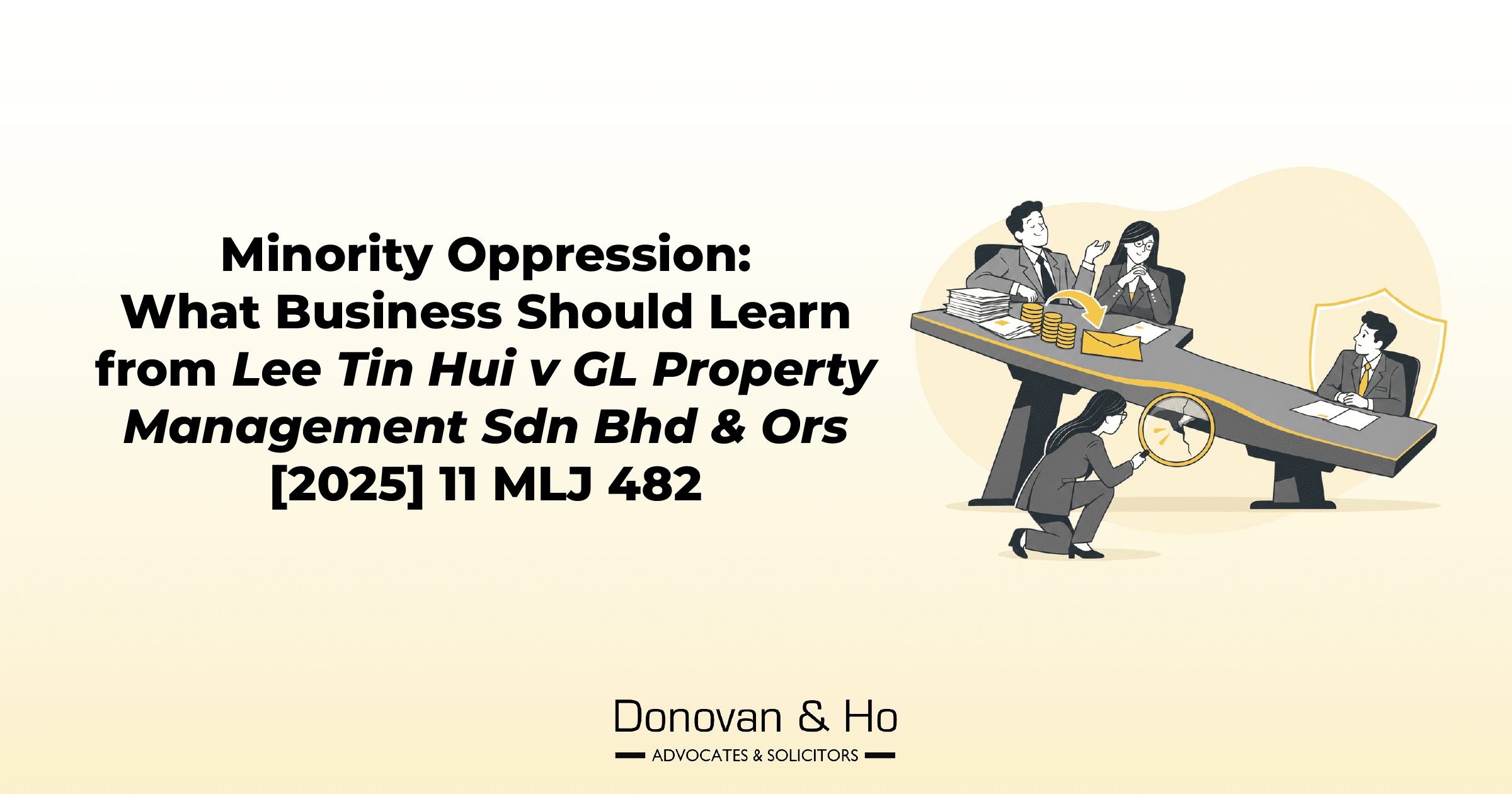
Many private and family-owned companies are run informally. Salaries get bumped up, loans get taken when cash is needed, dividends often made without proper corporate approval and no one thinks twice about it, because “it’s a family business” or “we are all shareholders anyway.” The High Court’s decision in Lee Tin Hui v GL Property Management Sdn Bhd & Ors [2025] 11 MLJ 482 is a timely reminder that this kind of informality can expose a controlling shareholder to a costly minority oppression claim under section 346 of the Companies Act 2016 (“CA 2016”) and, in a worst-case scenario, a forced buyout or even winding up of the company.
This article summarises the case and more importantly, sets out the practical lessons business owners should take from it.
What Happened
GL Property Management Sdn Bhd (“the Company”) was a small, family-owned investment holding company. Its sole business was collecting rental income from one property. It had only two issued shares.
Before 2017, one shareholder held 50% and a second family member (the plaintiff’s father, then a director) held the other 50%. When the father passed away in 2017, his share was divided under his will: half to his son (the second defendant), and a quarter each to his two daughters (including the plaintiff). This brought the son’s total shareholding to 75%, with the two daughters holding 12.5% each.
The son and his wife then took over as directors and ran the Company for the next several years. Over that period:
- They drew RM925,101 in interest-free, repayable-on-demand loans from the Company between 2018 and 2021, without proper shareholder approval.
- Their remuneration rose sixfold, from RM30,000 in 2019 to RM180,000 a year from 2021 onwards. Even though the Company’s revenue barely moved and its business had not changed.
- No dividends were declared between 2017 and 2020, despite the Company being profitable for at least part of that period.
- In 2023, dividends of RM50,000 were declared even though the Company had recorded an operating loss, allegedly to enable the majority shareholder to repay his unauthorised loans using his dividend entitlement.
- The minority shareholder (Plaintiff) also complained that the directors failed to provide notices of meetings and information regarding the Company’s affairs.
The plaintiff commenced an oppression action under section 346 of the CA 2016. The High Court allowed the oppression action and held that the affairs of the Company were conducted in a manner oppressive to the minority shareholder.
Why the Court Found Oppression
1. It is about the pattern, not any single decision.
The Court emphasised that oppression must be assessed holistically by looking beyond the legal form of each transaction and examining its practical effect. Rather than analysing the loans, directors’ remuneration, dividend policy, and lack of information in isolation, the Court considered their cumulative effect and asked what this pattern of conduct, taken as a whole, actually achieved.
The answer was that every mechanism used to extract value from the Company was available only to the majority shareholders in their capacity as directors. Viewed collectively, this revealed a deliberate pattern of self-enrichment rather than ordinary business management and demonstrated that the majority had used its control to benefit itself at the expense of the minority shareholders.
2. Director Remuneration Requires Proper Approval
The Court reaffirmed that directors have no automatic entitlement to remuneration. In this case, their remuneration must be authorised in advance by approval of the shareholders in general meeting as required in the Company’s constitution. Directors cannot pay themselves first and seek shareholder approval years later. This is particularly so where the benefiting directors control the majority of the voting rights. In such circumstances, retrospective ratification does not cure the impropriety. Instead, it may reinforce the perception that the majority has used its voting power to legitimise self-serving conduct at the expense of the minority shareholders.
3. Exempt Private Company Does Not Mean Full Exemption
The defendants argued that because the Company was an exempt private company, the restrictions on directors’ loans under section 224 of the CA 2016 did not apply to them at all. The Court disagreed.
Under the old Companies Act 1965, exempt private companies enjoyed a blanket exemption from the restrictions on loans to directors. The exemption was built directly into the operative provisions. For example, section 133 expressly states that “a company (other than an exempt private company) shall not make a loan to a director of the company”. As a result, an exempt private company fell outside the scope of the statutory prohibition altogether. No shareholder approval, repayment mechanism or other statutory conditions under those provisions applied. Qualifying as an “exempt private company” was sufficient to avoid the restrictions.
However, the CA 2016 changed this position. Section 224 no longer excludes exempt private companies from its application. It brings them within scope but gives them a lawful route to make the loan through conditions that must actually be satisfied, namely the approval requirements under section 224(3) or (4) or the repayment obligations under section 224(5). In other words, an exempt private company today is simply a company that must independently satisfy section 224’s requirements. Many business owners (and even some advisors) continue to assume that the older, more relaxed regime carries over under the CA 2016. It does not.
4. A dividend declared for the wrong reason is still a problem, even if it’s paid to everyone.
Although the 2023 dividend was declared on a pro rata basis and was not discriminatory on its face, the Court looked beyond its form to its commercial substance. The dividend was declared when the company was operating at a loss, and the retained profits relied upon to justify the distribution were substantially made up of outstanding directors’ loan receivables. The Court found that the declaration primarily enabled the second defendant to use his dividend entitlement to repay his unauthorised directors’ loans. While directors generally have discretion over dividend declarations, that discretion must be exercised for a genuine commercial purpose and in the interests of the Company as a whole, not as a mechanism to facilitate the personal financial interests of controlling shareholders.
5. “No mandatory AGM” doesn’t mean “no duty to inform.”
Although the CA 2016 abolished the mandatory annual general meeting (“AGM”) requirement, the Court held that directors remain under a duty to keep shareholders reasonably informed of material developments. Directors cannot use the absence of AGMs as a reason to withhold information. In this case, the directors refused to provide management accounts, dismissed legitimate shareholder enquiries, and only convened meetings to ratify their own remuneration. The Court found that this lack of transparency formed part of the overall pattern of oppressive conduct.
Practical Takeaways for Business Owners
This case is a useful checklist of what NOT to do and what good corporate governance looks like in practice.
- Formalise corporate decisions by ensuring directors’ remuneration, loans and dividends are properly approved, comply with the requirement of CA 2016.
- Put in place a robust shareholders’ agreement that clearly addresses remuneration, dividend policy and dispute resolution.
- Maintain good corporate governance by regularly reviewing compliance with the CA 2016 and the company’s constitution.
- Majority shareholders should not use their control to benefit themselves at the expense of minority shareholders.
***
This article was written by Jocelyn Lier (Associate) with the assistance of Sonia Lim (Intern) from Donovan & Ho’s corporate practice.
Our corporate practice group advises on corporate acquisitions, restructuring exercises, joint venture arrangements, shareholder agreements, employee share options and franchise businesses, Malaysia start-up founders and can assist with venture capital funds in Seed, Series A & B funding rounds. Feel free to contact us if you have any queries.